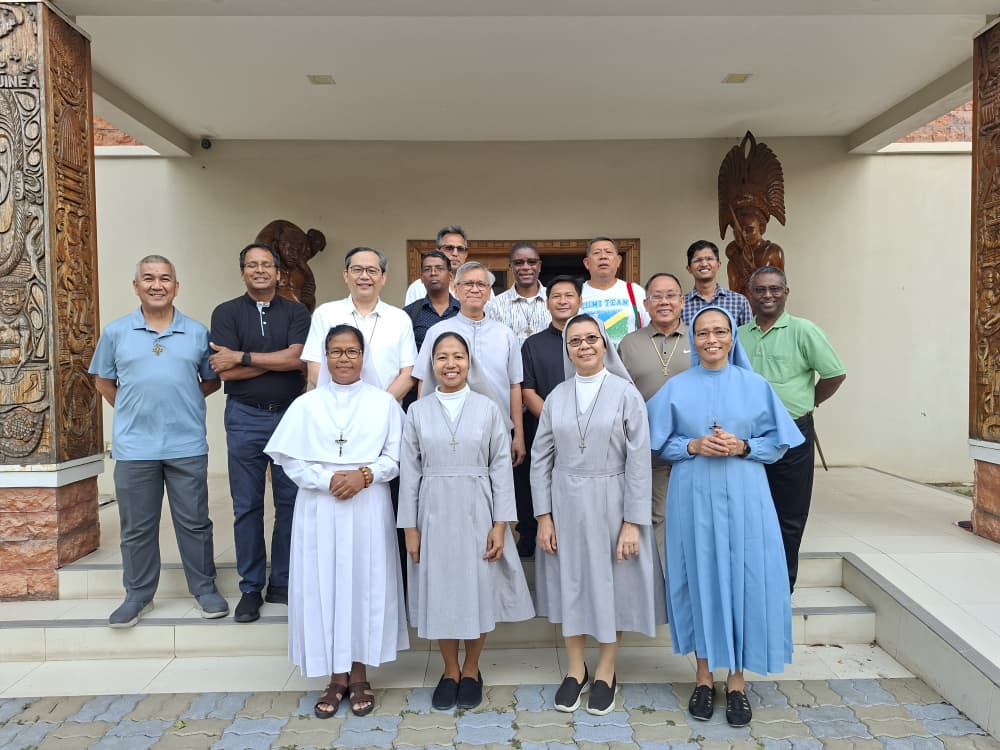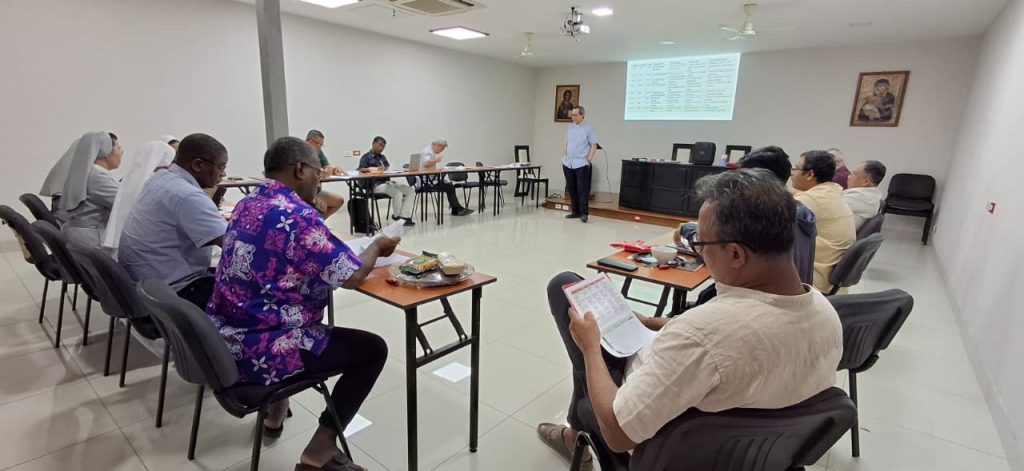
Three-day seminar brings together 15 members of the Salesian Family to reflect on leadership, institutional management, and crisis communication
PORT MORESBY, June 12 — Eleven Salesian leaders and Four members of the Salesian Family of the Province of Papua New Guinea and Solomon Islands (PGS) participated in a three-day workshop on Social Communication held from June 10 to 12, in a programme designed to sharpen their capacity to govern persons, communities, and institutions in fidelity to the Salesian mission.
The seminar, titled "Governing the Mission," was facilitated by Fr. Fidel Maria Orendain, SDB, General Councillor for Social Communication of the Salesians of Don Bosco. He was invited by the Provincial of PGS, Fr. Greg Bicomong Jr., to lead a programme aimed at integrating Salesian leadership, managerial discipline, and intentional communication into the daily practice of governance.
Day One: Who Governs the Mission
The opening day was devoted to the theme "Who Governs the Mission," with each session followed by structured reflection and group sharing. Fr. Orendain introduced the AKS framework — Attitudes, Knowledge, and Skills — as a diagnostic lens for leaders to assess their own readiness for governance. He stressed that mission becomes difficult when leaders fail to hold these three elements in balance, and urged participants to cultivate self-awareness as a foundation for effective and evangelically grounded service.
Fr. Raffy, Rector of Rapolo, described the day's sessions as "very reflective and in depth," noting that the AKS framework had prompted him to examine where he himself stood along those lines.
Day Two: Communication as a Governance System
The second day took up the theme "We Govern Together — Communication, Participation, and Community Effectiveness." Sessions focused on reframing communication not as an accessory to leadership but as a governance system in its own right. Participants were guided in building clear internal communication protocols at provincial, community, and institutional levels, and in practising what Fr. Orendain described as preventive communication — proactive measures aimed at managing conflict and sustaining community health before tensions escalate.
Day Three: Navigating Crisis
The final day addressed the challenge of Crisis Communication, widely acknowledged by participants as among the most demanding dimensions of leadership. Fr. Shoji, reflecting on the session, observed that when things go wrong, leaders often lack a clear framework for response, which can compound panic among fellow members and those they serve. Fr. Alfred offered a complementary insight, noting that early identification and prompt action are decisive: "The moment one sees the problem, it needs to be addressed immediately. To avoid a crisis, one must nip the problem in the bud itself. When this fails, the problem becomes beyond control." The day provided practical frameworks for communicating with clarity and composure in difficult moments.
Outcomes
The workshop concluded with participants expressing that the seminar had offered clear direction for their mission and yielded concrete points for ongoing reflection. Several described the programme as having helped them understand their service of governance in more meaningful and authentic terms.
The three-day seminar forms part of broader efforts by the PGS Province to build the institutional and communicative capacities of its leadership in a region where the Salesians operate a range of educational, pastoral, and social works.